
The Lifeline program has been around since 1985 and remains one of the most legitimate federal resources available today. While many still casually refer to it as the ‘Obama Phone’ program, it has evolved into a sophisticated digital safety net managed by the FCC.
In 2026, with the introduction of the Safe Connections Act, this program has expanded beyond just basic connectivity, it now offers critical emergency support for survivors and long-term stability for SSI recipients. However, because millions rely on these essential services at no cost, it has also become a primary target for scammers.
Understanding the real 2026 regulations is the only way to protect your benefits from predatory ‘free phone’ traps.
It’s important to know that the Lifeline program is managed by the Federal Communications Commission (FCC) and administered by the Universal Service Administrative Company (USAC).
This stable federal resource ensures that low-income households, including those receiving SSI, can access crucial communication services, which translates to getting a free phone with SSI.
Legitimate providers, like Assurance Wireless and SafeLink Wireless, partner with the government to deliver these benefits.
SSI Eligibility
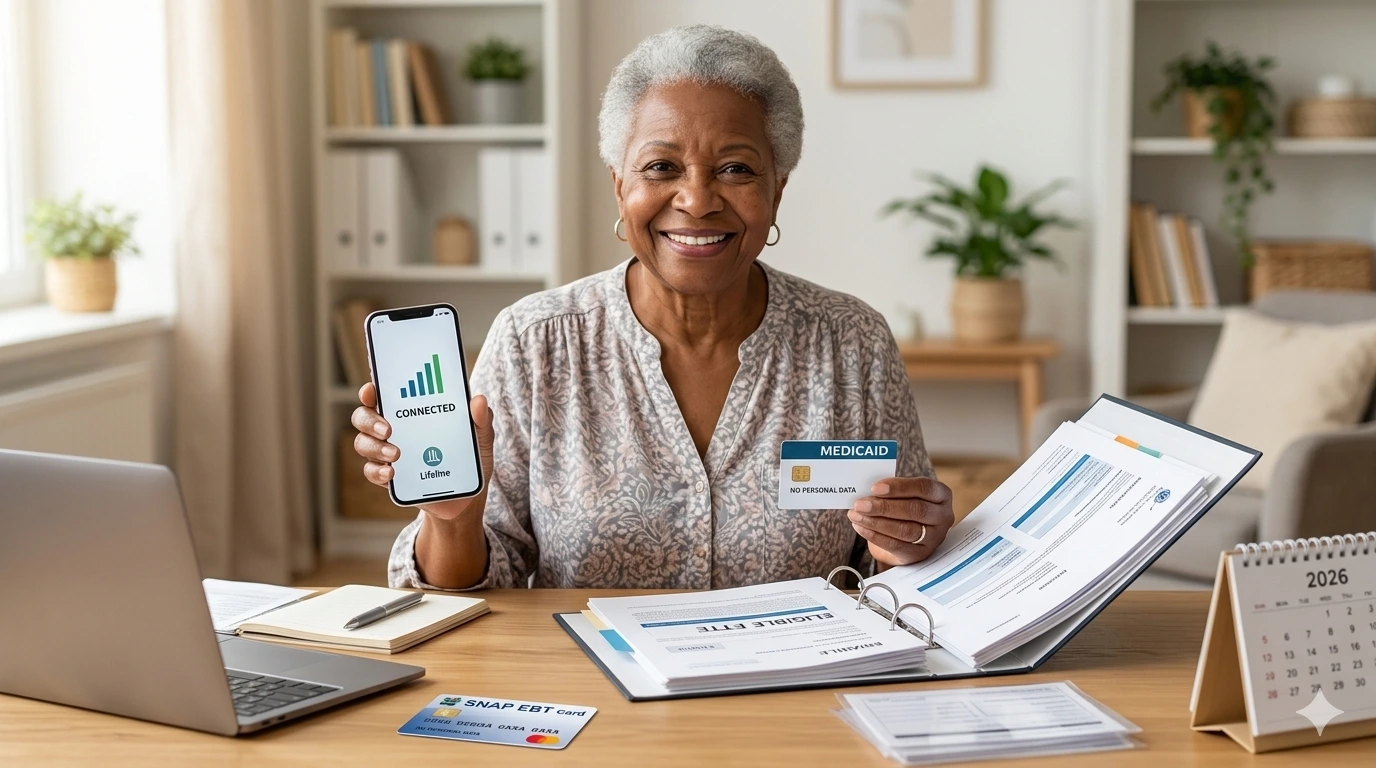
If you qualify for Lifeline service, SSI eligibility is straightforward. You won’t need to submit separate income tax returns if you can provide an official Benefit Verification Letter or an SSA-1099 form from the Social Security Administration, dated within the last 12 months.
The primary benefit of free phone services using SSI is a $9.25 discount on your phone and internet bills. For individuals on tribal lands, the discount is higher at $34.25. When you apply through a participating provider, they will apply this credit to a specific plan, which can often result in a $0 monthly bill, along with a free device.
How to apply safely?
To ensure you are accessing the legitimate program, follow these guidelines:
- Use Official Portals: Apply directly through the National Verifier or your state’s official utility commission if you’re in Texas or Oregon.
- Verify the Provider: Confirm that the company is an Eligible Telecommunications Carrier (ETC). Trustworthy providers will direct you to the National Verifier or a state administrator to validate your eligibility.
- Check for BYOD Options: Most legitimate providers will allow you to Bring Your Own Device (BYOD), a good sign indicating a genuine service rather than a hardware-only scam.
Documentation You Need
To fulfill the requirements of the National Verifier in 2026, any manual documentation submitted must contain the recipient’s full legal name (matching the application), the name of the program (Supplemental Security Income), the issuing agency (Social Security Administration), and an issue date that’s within the last 12 months or a future expiration date.
Benefit Award Letter: This is the original document issued when SSI benefits are first approved. While many keep it long-term, for Lifeline purposes, it must be the version that reflects the current year’s benefit amount.
Benefit Verification Letter: Often referred to as a budget letter or proof of income letter, this is the most reliable document in 2026, and it can be downloaded instantly from the my Social Security portal.
Major 2026 State developments
Several states introduced significant changes in early 2026 that are important for you to be aware of:
- California: As of February 1, 2026, the enrollment process has changed. Residents are now required to confirm their eligibility through both the National Verifier (federal) and the California LifeLine Administrator (state). California continues to lead with the highest data caps; some providers offer 25 GB of data, exceeding the 10 GB national average.
- New Mexico: In February 2026, the state launched the Low-Income Telecommunications Assistance Program (LITAP), which directly replaces the now-defunct ACP, offering an additional $30 subsidy ($75 on Tribal lands) for households receiving SSI.
- Oregon: Recently, the state introduced a $100 one-time device discount to help low-income residents, including SSI recipients, purchase high-end smartphones or computers.
- New York: Under the Affordable Broadband Act, large internet providers are required to offer a $15 per month high-speed plan (with at least 25 Mbps) to any household on SSI.
Available free phone vs. SIM card
It’s essential to understand that the government doesn’t provide phones directly. In 2026, providers leverage the Lifeline subsidy to offer various hardware tiers:
- Refurbished Flagships: Companies like AirTalk Wireless and Cintex Wireless focus on refurbished high-end devices, including models such as the iPhone 7, iPhone 8, iPhone XR, and Samsung Galaxy S20 series.
Stay informed and explore your options with the Lifeline program to ensure you’re getting the benefits available to you!
| Brand/Model | Category | Initial Cost with Lifeline | Retail Market Value (2026) |
| iPhone 7 | Free Tier | $0 | $80.50 |
| Hotpepper Verde (New) | Free Tier | $0 | $100.00 |
| AirVoice S67 5G (New) | Upgrade Tier | $19.99 | $149.99 |
| iPhone 8 | Upgrade Tier | $54.99 | $92.00 |
| Samsung Galaxy A71 5G | Upgrade Tier | $79.99 | $190.00 |
| iPhone XR | Upgrade Tier | $129.99 | $178.25 |
- New Budget Androids: Assurance Wireless and Gen Mobile typically offer new, entry-level Android smartphones, featuring brands like Hotpepper or Schok.
- SIM-Only (BYOD): Many providers, especially SafeLink Wireless, are now promoting a Bring Your Own Device model, sending a free SIM kit rather than a phone for quicker activation. However, do note that they rarely permit this option outside California.
Data, Talk, and Text plans
Data and calling plan values have seen a slight increase in the post-ACP market to remain competitive.
- Assurance Wireless: The standard plan includes 10 GB of high-speed data with unlimited talk/text. For just $1 a month or $10 a year, you can upgrade to a Data Peace of Mind plan, which provides 15 GB.
- SafeLink Wireless: Offers 10 GB of data (including a 5 GB hotspot) nationwide, which increases to 25 GB of data and a 10 GB hotspot in California. They also have a $20 unlimited data top-up option.
- AirTalk Wireless: Usually provides 5 GB of data for BYOD plans, but offers higher amounts (up to 15-25 GB) in California or for Tribal residents.
Managing Your Account and Porting
- BYOD: The majority of providers support Bring Your Own Device, meaning you’ll need an unlocked, compatible 4G/5G phone and will receive a free SIM kit.
- Porting: You can keep your current number. For this, you need your account number and a porting PIN from your existing carrier. Keep your old service active until the transfer is finalized.
- Unlocking: Typically, SafeLink phones can be unlocked for use with other carriers after 60 days of active service.
Why was my account deactivated?
- Q Link Wireless Warning: In 2025, Q Link was permanently barred from federal programs following a significant fraud investigation. The CEO, Issa Asad, was sentenced to five years in prison for laundering over $100 million in Lifeline funds. Users should avoid any street or robocall offers claiming to be from Q Link.
- The 30-Day Rule: To maintain your free service, usage is required at least once every 30 days. This includes making a call, sending a text, or using mobile data while not connected to Wi-Fi.
- Annual Recertification: Every 12 months, you need to recertify your SSI eligibility. The National Verifier will try to do this automatically using the SSA database, but if it fails, you will have 60 days to provide manual documentation.
Hidden Costs and Scams
- Activation Fees: Most providers do not charge fees, but Life Wireless may impose a one-time $50 activation fee for physical SIMs or eSIMs in certain states, such as Texas and California.
- Scam Red Flags: Be cautious of vendors requesting upfront shipping fees or reward collection fees. Legitimate providers will direct you to the National Verifier for eligibility checks and will not ask for sensitive information via social media messages.
- Local Events: To locate legitimate local vendors, use the official Companies Near Me tool at cnm.universalservice.org.
The 2026 digital safety net is no longer a monolith. It is a dynamic, highly regulated ecosystem that rewards the informed participant. While the free phone remains a core right for those on Supplemental Security Income, the quality of that experience is now firmly in the hands of the recipient and their ability to navigate the state and federal frameworks that define modern telecommunications access.